storage questions
Does a Peptide Expire?
Research material usually carries a retest date rather than an expiry date, and the two commit the supplier to different things. One says do not use. The other says do not assume — measure.
Research material usually carries a retest date rather than an expiry date, and those are not two names for the same thing. They commit the supplier to different claims, they are established by different work, and confusing them produces two opposite mistakes — trusting an undated vial too much, and condemning a perfectly good one because a printed date has passed.
The short version: an expiry date says the product will meet its specification up to that day and should not be used after it. A retest date says the material was in specification when tested, and after that day the correct response is to test it again rather than to discard it 12.
A great deal of research material carries neither, for reasons that are worth understanding rather than resenting. Both dates are outputs of stability work, and where that work has not been done there is nothing honest to print.
What is the difference between a retest date and an expiry date?
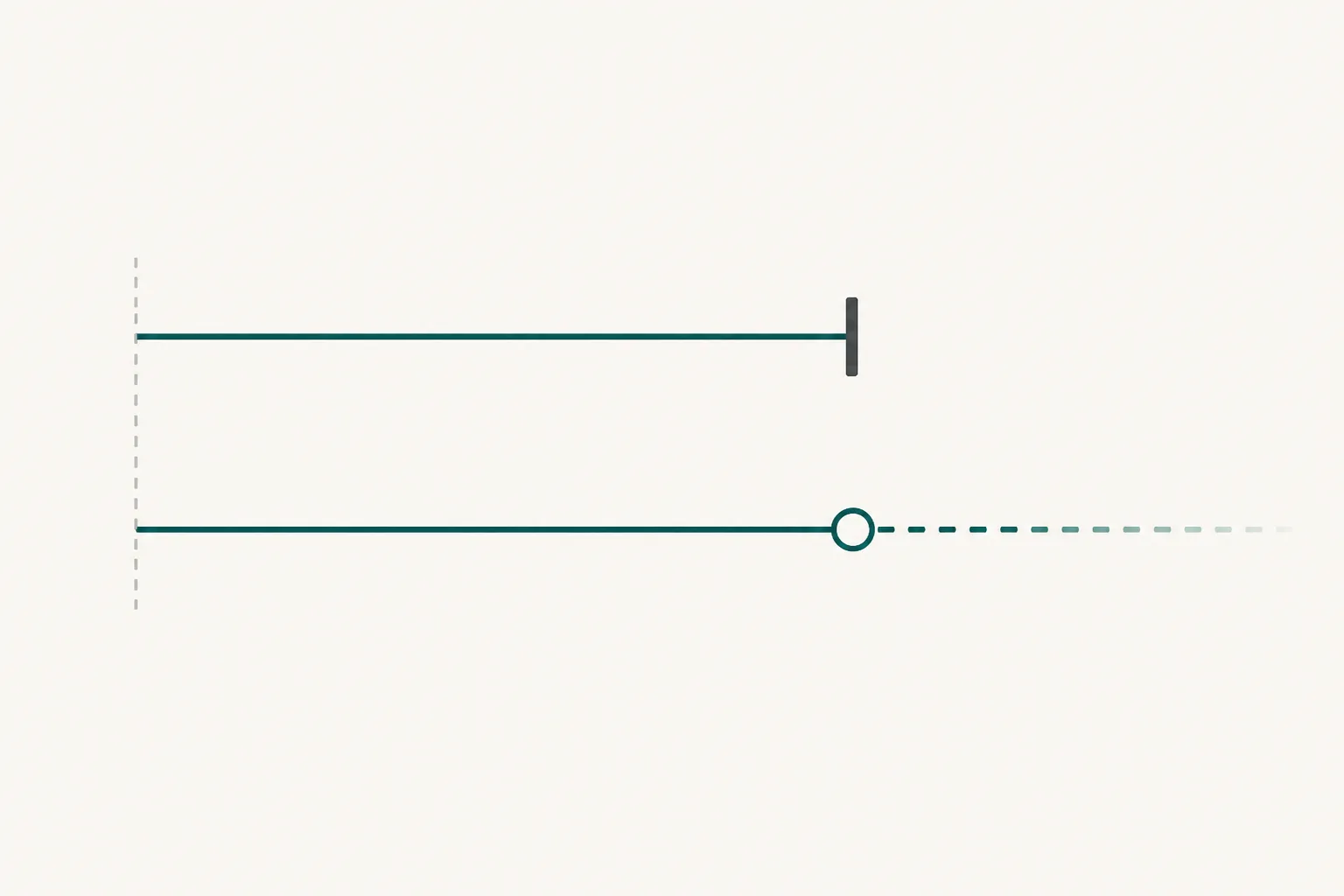
An expiry date ends the material's life; a retest date interrupts it with a question. That is the whole distinction, and everything else follows from which of the two a supplier has actually committed to.
An expiry date is a property of a finished product. It states that, stored under the conditions on the label, the product will remain within its specification until that day. It is established by stability testing — the specific formulation, in the specific container, held under defined conditions, sampled on a schedule, and analysed by methods capable of detecting the degradation products that matter 1. The date is the point to which that evidence extends.
A retest date is a different instrument and belongs to a substance rather than a packaged product. Past a retest date the material is not condemned. It is re-examined against specification, and if it passes it can be used, with a new retest date set from that point. Manufacturing guidance for active substances describes exactly this arrangement, alongside expiry dating, as the normal way stable substances are handled 2.
The reason both conventions exist is that they suit different materials. Some degrade predictably enough that a fixed cut-off is the right call. Others degrade slowly and unevenly, and for those a fixed cut-off would discard sound material while a measurement would not 2. Retest dating is the honest option for a substance whose condition is knowable by testing but not confidently predictable by the calendar.
Which yields a simple reading rule. An expiry date says: after this, do not use. A retest date says: after this, do not assume.
Why does research material often carry neither?
Because neither date can be issued without the programme that generates it, and that programme is expensive, slow, and specific to one formulation in one container. Research compounds are supplied outside that framework by definition.
Consider what the work involves. Material is held under defined storage conditions for the full duration being claimed, with samples pulled on a schedule and analysed by methods validated to detect the particular degradation products the compound produces 13. It takes as long as the claim it supports. A twelve-month shelf life requires twelve months of held material — accelerated testing informs the design and narrows the uncertainty, but the real-time data is what the date rests on 1.
It is also non-transferable in a way people underestimate. The result belongs to that sequence, at that fill, in that container closure, at that pH, under those conditions. A related peptide in a different vial has not been covered by it, and neither has the same peptide held differently 13.
So the absence of a date on research material is not necessarily evasion. It is frequently the accurate representation of the position, which is that nobody ran the study. A supplier can honestly report what a batch was when it was analysed. Issuing a shelf life is a much larger claim, and one that cannot be made truthfully on the strength of a single analysis performed once 3.
What does a printed date mean without stability data behind it?
Very little, and it is worth being specific about what it is not. A date with no study behind it is at best a policy — a fixed interval applied uniformly to everything a supplier ships, chosen for administrative tidiness rather than derived from any measurement of that compound.
It fails in both directions, which is the giveaway that it is not carrying information. It can be over-generous, implying an integrity that was never demonstrated and lending a vial an air of certification it has not earned. It can equally be over-conservative, condemning material that would have passed analysis comfortably. A number that can be wrong either way, with no way to tell which, is not a measurement 13.
There is a subtler problem too. A printed date invites the calendar to substitute for the record. Once a vial has a date on it, the questions that actually bear on its condition — how it was held, what happened to it in transit, how many times it was taken in and out of cold storage — tend to stop being asked, because a date appears to have answered them. It has not; it knew none of them.
| What is printed | What it is founded on | What it entitles you to conclude |
|---|---|---|
| An expiry date | Real-time stability testing of that formulation in that container | The product met specification to that date under the stated conditions |
| A retest date | Stability data supporting an interval after which re-examination is required | The material should be tested again, not discarded |
| A date from a blanket supplier policy | An administrative convention applied to everything | Nothing about this compound in particular |
| A certificate of analysis date | Analysis actually performed on that batch on that day | What the material was on that day, and nothing about later |
| No date at all | No stability programme having been run | That the batch's own history is the only record available |
The document actually worth reading is the last of those. A certificate of analysis names the batch, the methods, the results and the date on which the work was done — which makes it a record of something that happened, rather than a prediction about something that has not 3.
How should material with no date at all be treated?
As undated material, which is what it is, with the batch's own history standing in for the date it does not have. That is a weaker position than a validated shelf life and a considerably stronger one than pretending the question has an answer.
The chemistry supplies the frame. A dry lyophilised solid held dry, cold and dark is a slow reaction rather than a stopped one; hydrolysis, deamidation, oxidation and aggregation all continue at reduced rate, and none of them alters the appearance of a white powder as they proceed 34. Age is therefore a real variable even when nothing looks wrong, and the absence of a date does not suspend it.
The record supplies the rest. When the batch arrived, what the certificate said and when it was issued, how the material has been held since, whether it has been through anything unusual — that is the only substitute for a stability programme available, and it costs nothing beyond the discipline of writing it down at the time 3.
Retest thinking generalises well to this situation, and is the most useful thing to borrow from the formal framework. The question is not whether some interval has elapsed. It is whether the material has been characterised recently enough to stand behind for the use in front of you 2. Framed that way, the answer for old material is analysis rather than arithmetic — and inspection, which is what most people reach for, answers nothing at all 3.
So does a peptide expire?
A peptide degrades, continuously and invisibly, whether or not anything is printed on the vial. Whether it expires in the formal sense depends entirely on whether somebody did the stability work that turns degradation into a date 13.
For most research material nobody did, which is why a retest date is the more honest instrument and why many vials carry no date at all. Neither absence means the material is fine, and neither means it is not. It means the calendar is not the place to look 2.
What is left is less tidy than a printed date and rather more informative: what the material was when it was last analysed, how long ago that was, and what has happened to it since. That is the actual state of knowledge about a research compound, and a date that papers over it is not adding information — it is concealing the fact that there is little.