direct comparisons
Ipamorelin vs CJC-1295: What Is the Difference?
They act on two different receptors. Ipamorelin is a secretagogue that copies a stomach hormone; CJC-1295 is a modified copy of a hypothalamic releasing hormone. Nearly every other difference follows from that one.
They act on two different receptors. Ipamorelin binds the growth hormone secretagogue receptor, the same receptor the stomach hormone ghrelin acts on 12. CJC-1295 is a modified copy of growth hormone-releasing hormone and binds the growth hormone-releasing hormone receptor, a separate protein with a separate gene and a separate natural ligand 34. Both receptors sit on the same population of pituitary cells, and activating either one leads to growth hormone being released, which is why the two compounds are filed under one heading. But they reach that cell through different doors, and almost every real difference between them follows from that fact, including the very large gap between how long each one persists in the body.
What is a growth hormone secretagogue?
A secretagogue is anything that makes a gland secrete something it already holds. Ipamorelin is a synthetic peptide of five amino acids that binds the growth hormone secretagogue receptor on pituitary cells and prompts them to release stored growth hormone 1. The receptor was named and characterised before anyone knew what the body's own molecule for it was. That molecule turned out to be ghrelin, isolated from the stomach and reported in 1999 2. So the cleanest description of ipamorelin is a small synthetic stand-in for a gut hormone, acting on a receptor in the gland that controls growth.
The finding ipamorelin is actually known for is selectivity. Earlier compounds in the same family raised cortisol and prolactin alongside growth hormone, which made their effects difficult to attribute to any one hormone. When ipamorelin was first described in 1998, it was reported to trigger growth hormone release in rats and pigs without the accompanying rise in those other hormones seen with its predecessors 1. That is a genuine and specific result, and it is worth being precise about what kind of result it is: an animal pharmacology finding from the compound's original characterisation, not a demonstration of an outcome in people.
One structural consequence matters for the comparison. Because a secretagogue works by pushing an existing secretory mechanism rather than by supplying growth hormone itself, whatever it does is bounded by what the pituitary holds and by the feedback that governs release. That is a statement about mechanism and not a safety claim, and it should not be read as one. It simply means that a secretagogue and an administered growth hormone are different kinds of intervention, so results obtained with one do not transfer to the other.
What is a releasing-hormone analogue?
It is a deliberately modified copy of a hormone the body already makes. Growth hormone-releasing hormone is a 44-amino-acid peptide produced in the hypothalamus; it was first characterised in 1982 from a pancreatic tumour that happened to be producing it in unusual quantity, which is how enough material was obtained to sequence it at all 3. Its job is to travel a short distance to the pituitary and instruct it to release growth hormone. CJC-1295 is built on the first 29 residues of that hormone, the shortest fragment that retains full activity, carrying a small number of amino acid substitutions.
Those substitutions exist for one reason. The natural releasing hormone is dismantled within a few minutes by an enzyme that clips two amino acids off its exposed end, and a molecule with a lifetime that short is awkward to study and awkward to develop. The substitutions sit at and around the enzyme's preferred cut site and slow that reaction down. A second and separate modification adds what its developers called a drug affinity complex: a reactive chemical group that forms a lasting bond with albumin, the most abundant protein in blood. Bound to albumin, the peptide is carried around rather than cleared quickly, and it is this version that produced the multi-day hormone responses reported in healthy adults 4.
Why are they always discussed together?
Because the receptors are separate, and separate receptors invite the assumption that activating both achieves more than activating either. That assumption is the entire basis of the pairing. It is an inference from receptor biology rather than a result reported by a study, and the distinction matters more here than anywhere else on this page.
The reasoning runs like this. The body's own control of growth hormone release involves more than one input: the hypothalamic releasing hormone drives it, somatostatin restrains it, and the ghrelin arm modulates it from a third direction 23. Two compounds acting on two of those inputs are therefore argued to be complementary rather than redundant. As a description of the control system, that is accurate physiology. As a prediction about what two synthetic compounds do when both are present, it is untested, because combination effects are not reliably derivable from single-agent pharmacology. This is exactly why drug development treats a combination as its own question with its own trial rather than as arithmetic.
So the honest summary of the pairing is that it is discussed far more than it has been examined. This article compares two mechanisms and does nothing else. It describes no combination, no sequence, no schedule and no quantity, because there is no published controlled human work that would support describing any of those things. A pairing that circulates widely and has never been measured is a popular idea, not a finding.
How long does each one last?
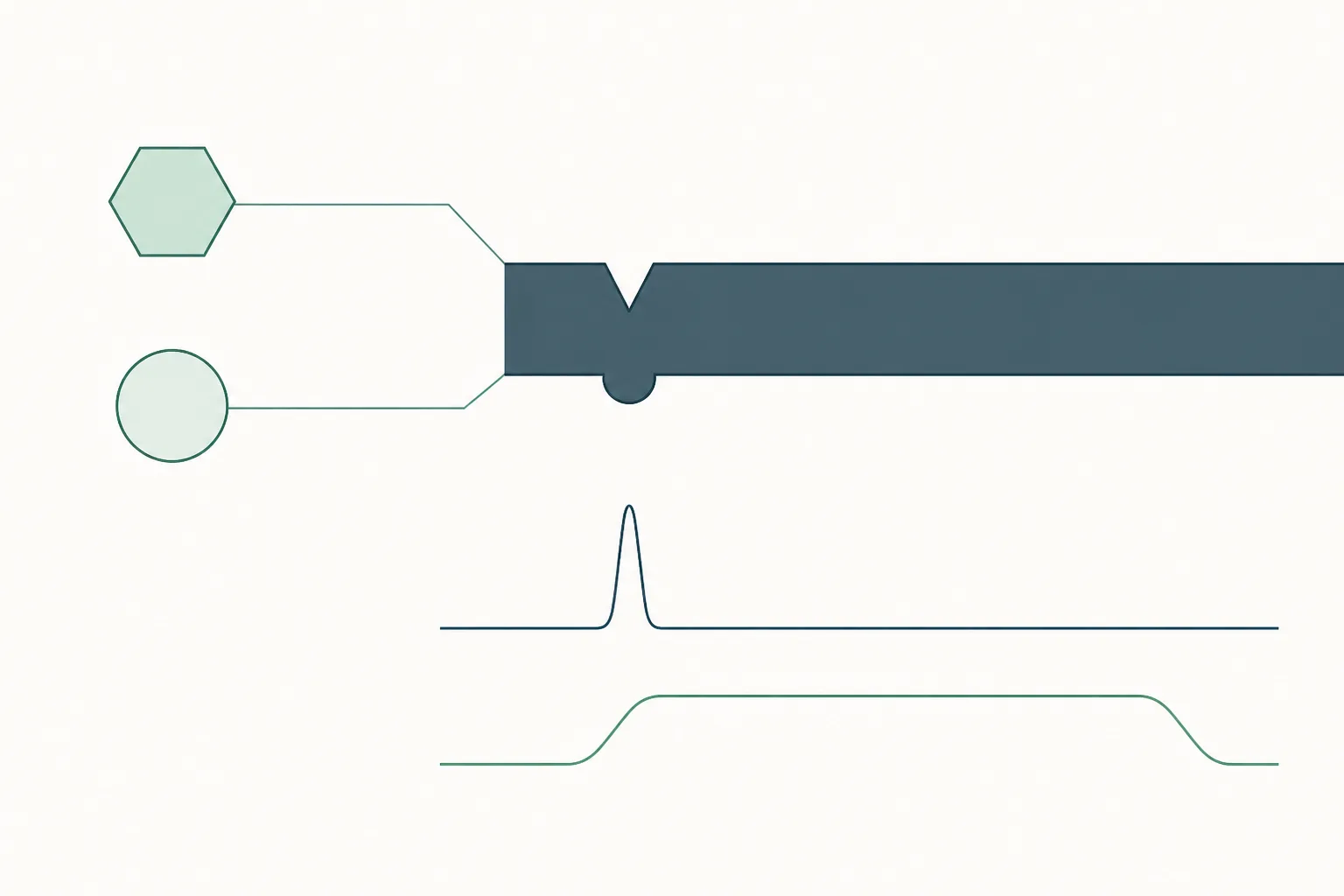
Ipamorelin is cleared within hours, while the albumin-binding version of CJC-1295 remains measurable for days 14. That is the single largest quantitative difference between them, and it changes what kind of experiment each compound belongs in.
In the human study most often cited for CJC-1295, healthy adults given a single administration showed growth hormone concentrations elevated for days afterwards, with insulin-like growth factor 1 — the downstream marker that responds more slowly and averages out short fluctuations — remaining above baseline for a week or more 4. Ipamorelin's published profile has the opposite shape: a sharp rise and a return towards baseline within hours 1.
What that changes about study design is more interesting than the numbers themselves. A short-acting compound can be studied with frequent blood sampling across a single session, and a crossover design can put the same subject through two conditions a few days apart with reasonable confidence that nothing is left over from the first. A compound with a multi-day tail cannot be studied that way. It needs long washout periods, it makes crossover designs slow and expensive, and it pushes the choice of endpoint away from the immediate hormone pulse and towards slower integrated markers that are easier to measure but further from anything a person would notice.
There is a second consequence worth stating plainly. Growth hormone is normally released in pulses, and the pattern of those pulses is itself biologically meaningful rather than incidental. A compound that produces a brief pulse and a compound that produces a sustained elevation are therefore not two settings of one dial; they present the body with structurally different signals. Whether that difference matters for any particular outcome is an open question, but it is a good reason to distrust any comparison that treats duration as a mere convenience feature.
| Ipamorelin | CJC-1295 | |
|---|---|---|
| Class | Growth hormone secretagogue | Growth hormone-releasing hormone analogue |
| Receptor | Growth hormone secretagogue receptor | Growth hormone-releasing hormone receptor |
| Natural molecule it imitates | Ghrelin, made in the stomach | Releasing hormone, made in the hypothalamus |
| Size | Five amino acids | Twenty-nine residues, with substitutions |
| Why it resists breakdown | Synthetic sequence, not built from the natural ligand | Substitutions at the enzyme cut site, plus an optional albumin-binding group |
| Duration of measurable effect | Hours | Days, for the albumin-binding version |
| Published human hormone-response data | Limited | Yes, in healthy adults |
| Controlled trials with clinical endpoints | None published | None published |
| Approved medicine anywhere | No | No |
What is established and what is extrapolated?
Established: the receptor pharmacology of both, and for CJC-1295 a published human hormone-response profile. Extrapolated: essentially everything about outcomes. That division is sharper than most comparisons of this pair admit, and it runs the opposite way to what many readers expect, since the compound with the longer marketing history is not the one with the human data.
On the established side, the identity of each receptor is settled, the natural ligand for each is known, and the fact that activating either leads to growth hormone release is not in dispute 123. For CJC-1295 there is a published study in healthy human adults reporting what happened to growth hormone and insulin-like growth factor 1 concentrations over time 4. That is real human data, and it should be described accurately: it establishes that a hormone concentration moved, which is a pharmacological observation rather than a clinical outcome. Ipamorelin's public record is dominated by its original animal characterisation and by early development that never produced an approved product 1.
On the extrapolated side sits every claim about what either compound does to a tissue, a symptom or a person over time. No controlled trial with a clinical endpoint has been published for either compound in the uses they are usually discussed for. Moving a hormone concentration and producing a benefit are different claims requiring different evidence, and the step between them is where most confident writing about this pair quietly goes wrong.
- Neither compound is an approved medicine in the United States, the United Kingdom or the European Union.
- Both are supplied for laboratory research use only — material that has not been assessed, manufactured or released for administration to people.
- Growth hormone secretagogues and releasing-hormone analogues are both prohibited in competitive sport under World Anti-Doping Agency rules, which settles the question for any tested athlete whatever the science eventually shows.
- No controlled human trial has examined the two together, so nothing said about the pairing rests on measurement.
- Any comparison that does not specify which version of CJC-1295 it means is comparing an undefined object.
The short answer, then. Ipamorelin and CJC-1295 are not two strengths of one idea. One imitates a stomach hormone at one receptor and acts briefly; the other imitates a hypothalamic hormone at a different receptor and, in its albumin-binding form, acts for days. They converge on the same pituitary cell and diverge in nearly every other respect a comparison could examine. Then they converge again at the end, in the place that matters most: both stop well short of the controlled human outcome data that would let anyone say what either actually achieves.
References
- Ipamorelin, the first selective growth hormone secretagogue
- Ghrelin is a growth-hormone-releasing acylated peptide from stomach
- Characterization of a growth hormone-releasing factor from a human pancreatic islet tumour
- Prolonged stimulation of growth hormone (GH) and insulin-like growth factor I secretion by CJC-1295, a long-acting analog of GH-releasing hormone, in healthy adults