evidence questions 2026
Is Orforglipron a Peptide?
No. Orforglipron is a small molecule that activates the same receptor as the peptide GLP-1 drugs, which is why it can be swallowed without fasting rules. What that changes, and what it shares with the peptides it competes with.
No. Orforglipron is a small molecule, not a peptide. Lilly describes it as a small-molecule, non-peptide GLP-1 receptor agonist, and the FDA approved it for adults with obesity, or overweight with weight-related medical problems, on 1 April 2026, under the brand name Foundayo 1. It activates the same receptor as semaglutide and the other GLP-1 drugs, but it is not built from amino acids, and that is why it can be taken as a once-daily tablet at any time of day without food or water restrictions 1.
The confusion is understandable. Every GLP-1 drug before it, whether injected or swallowed, was a peptide, and the class is named after a peptide hormone. Orforglipron breaks that pattern. It shares a target and a family of effects with the peptide drugs, and differs from them in almost everything else: size, chemistry, how it binds, how it is made and how it is taken.
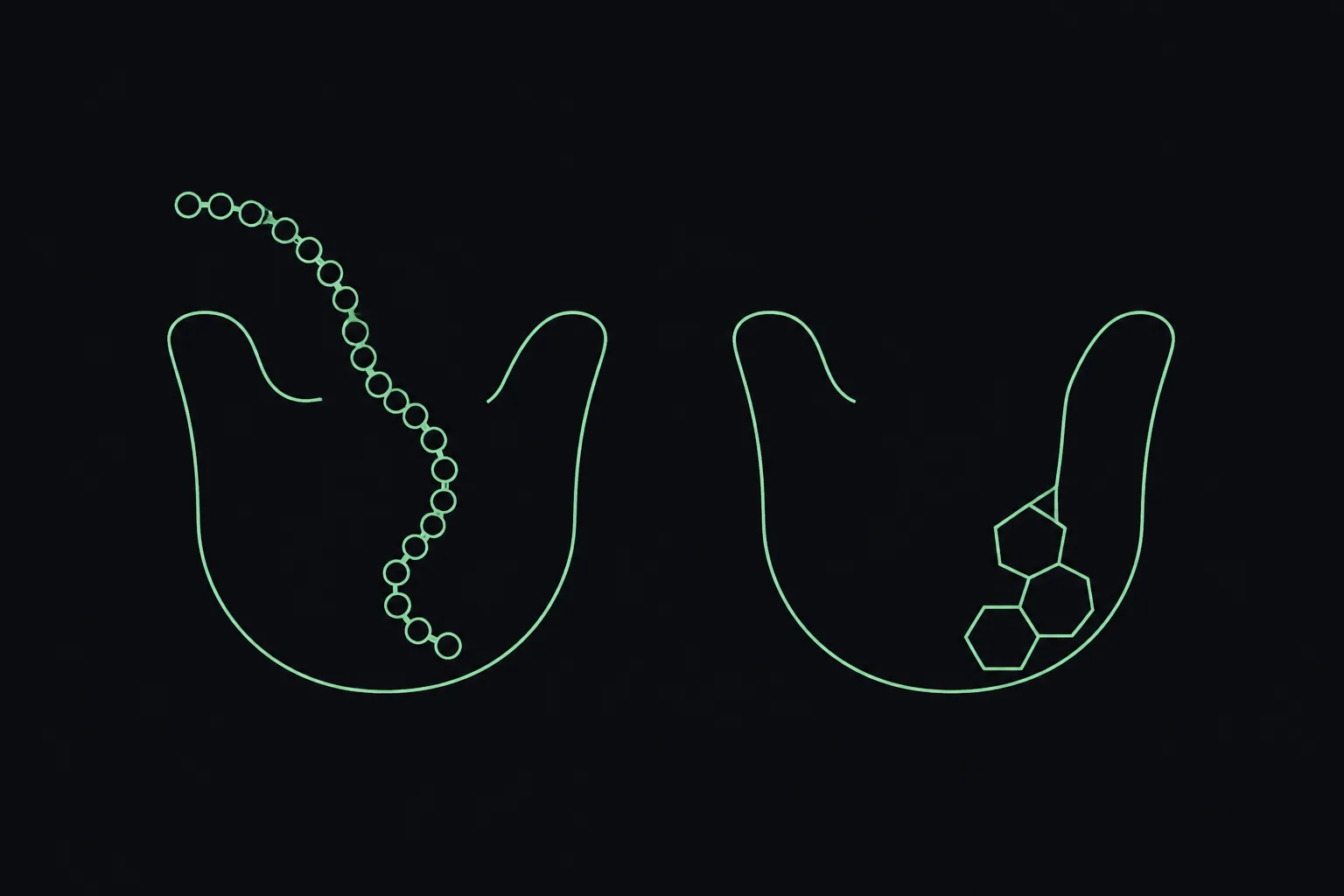
What is the difference between a peptide and a small molecule?
A peptide is a chain of amino acids joined end to end; a small molecule is a compact structure built by ordinary organic chemistry, usually far smaller and not assembled from amino acids at all. Semaglutide is a peptide: a modified version of the human GLP-1 hormone, with two amino acids changed and a fatty-acid chain attached so that it binds to albumin in the blood and lasts about a week 4. Its structure is a string of building blocks, like beads on a thread.
Orforglipron is not a string of anything. It is a single compact molecule built from rings and linking groups, the same general kind of structure as most tablets in a pharmacy. It is a fraction of the size of semaglutide. That difference in size and construction is what everything else on this page follows from.
If it is not a peptide, how can it activate a peptide hormone's receptor?
By binding to a different part of the receptor from the one the natural hormone uses. The paper that described the molecule, before it had its current name, solved its structure bound to the active GLP-1 receptor and found it sitting in a pocket high in the receptor's bundle of helices, held by the outer domain, one of the outer loops and several of the helices 3. A peptide hormone like GLP-1 is long enough to span a large surface of the receptor; a small molecule has to find a single pocket where it can grip hard enough to switch the receptor on.
The same paper found that it behaves differently from the natural hormone once bound. It is a partial agonist that favours one downstream signalling route — G-protein activation — over another, the recruitment of a protein called beta-arrestin 3. It also depends on an amino acid in the receptor that is specific to primates, which is one reason its activity differs between species 3. So orforglipron does not imitate GLP-1. It reaches a similar outcome by a different path.
Why did it take so long to find a non-peptide GLP-1 drug?
Because receptors built for peptide hormones are hard targets for small molecules. The GLP-1 receptor belongs to a family, known as class B receptors, whose natural partners are all peptides. Those hormones switch the receptor on by gripping it across a wide, fairly shallow surface, using many contact points along their length. A small molecule has far fewer contact points to work with, so it needs a pocket where it can bind tightly and still trigger the change in shape that activates the receptor.
Orforglipron found one, and the structural work explains why the search was not straightforward. The molecule is highly selective for the GLP-1 receptor over the other receptors in its family, and its activity depends on an amino acid found in the primate version of the receptor 3. That second detail is a practical headache for drug development, because the usual laboratory animals do not respond to it in the same way, which makes early testing harder than for a typical small molecule.
Why does being a small molecule matter for taking it by mouth?
Because the gut is designed to break peptides down, and small molecules are much better at getting through it intact. Digestion exists to split proteins and peptides into their amino acids, and the lining of the gut lets very little large material through. A peptide swallowed on its own is mostly digested and barely absorbed. That is why nearly every peptide medicine is injected.
A small molecule of the right design avoids both problems. There are no peptide bonds for digestive enzymes to cut, and it is small enough to cross the gut wall and enter the bloodstream. For orforglipron that means a once-daily tablet that can be taken at any time of day with no restrictions on food or water 1. For the people taking it, that is the practical difference. For chemists, it is the result of a long effort to find a non-peptide structure that could activate a receptor evolved for a peptide.
Isn't oral semaglutide already a GLP-1 pill?
Yes, and it is a peptide pill, which is exactly why the comparison is useful. The FDA approved an oral semaglutide tablet for weight management, under the Wegovy brand, in December 2025 6. So orforglipron was not the first GLP-1 tablet for this purpose. What it was is a GLP-1 receptor agonist that is not a peptide at all.
Getting a peptide like semaglutide to work as a tablet took a different solution. It is formulated with an absorption enhancer called SNAC. Studies in people and in dogs showed that the absorption happens in the stomach, in a small area right next to the tablet as it dissolves, and depends entirely on SNAC being present; SNAC buffers the local environment to protect the peptide from digestion and briefly helps it cross the stomach lining 5. That localised, delicate process is why oral peptide tablets come with strict instructions about fasting and water.
| Oral semaglutide | Orforglipron | |
|---|---|---|
| What it is | Peptide (modified GLP-1) | Small molecule, non-peptide |
| How it gets absorbed | Needs a co-formulated absorption enhancer, absorbed in the stomach | Absorbed as an ordinary small-molecule drug |
| Food and water rules | Strict conditions | None stated on approval |
| Where it binds on the receptor | Much the same way as the natural hormone | A distinct pocket in the upper part of the receptor |
Does it work the same way as the injectable GLP-1 drugs?
At the level of what it ends up doing, broadly yes; at the level of how it gets there, no. Activating the GLP-1 receptor slows stomach emptying, reduces appetite and increases insulin release when blood sugar is high, and those effects follow whatever activates the receptor. The side effects follow the same pattern: in the main obesity trial the most common in the highest arm were nausea, constipation, diarrhoea and vomiting, the same gastrointestinal profile as the peptide drugs 7.
The differences sit underneath. It is a partial rather than full agonist, it binds in a different place, and it favours one signalling route over another 3. Whether those differences matter for long-term outcomes is not known yet. What is known is that they did not stop it producing a clear effect on body weight in a large trial.
What did the trial behind the approval show?
A clear but smaller average body-weight change than the leading injectables, over seventy-two weeks. ATTAIN-1 randomised 3,127 adults with obesity and without diabetes, in nine countries, to one of three orforglipron arms or placebo 2. Counting everyone randomised, the highest arm reached an average change of 11.2% against 2.1% on placebo 2. Counting only those who stayed on treatment, the figure was 12.4% against 0.9% 1.
Stopping because of adverse events rose with the arm, from 5.3% in the lowest to 10.3% in the highest, against 2.7% on placebo 7. Those numbers are close to what injectable GLP-1 drugs have shown in their own trials, though comparing separate trials is always approximate. The trade-off being tested in the market is roughly this: a tablet with no fasting rules against an injection with larger average effects.
Does being a small molecule change how it is made or stored?
Yes, in the general ways that separate small molecules from peptides. A peptide has to be assembled amino acid by amino acid, or produced by cells and then chemically modified, and it has to be kept intact afterwards: peptides in solution can clump together, oxidise or break apart, which is why injectable peptide medicines are generally kept cold before use. A small molecule is made by a sequence of conventional chemical reactions and pressed into tablets, the way most medicines have been made for a century.
That is one reason there is so much interest in small-molecule GLP-1 drugs. Tablet manufacturing is a mature, very large-scale industry, and a dry tablet is usually far more forgiving to store and ship than a peptide solution. Those are general properties of the two kinds of product, not specific claims about any one brand.
So what is the short answer?
Orforglipron is not a peptide. It is a small molecule that switches on the GLP-1 receptor from a different binding site, and that is what lets it be swallowed as an ordinary tablet with no food or water rules 13. The peptide GLP-1 drugs, including oral semaglutide, remain peptides, which is why they are injected or need an absorption enhancer and strict conditions to work by mouth 5.
What it shares with them is the target, the general effect and the side-effect profile. What it does not share is the chemistry. The GLP-1 class is named after a peptide hormone, but orforglipron shows that a drug does not have to be a peptide to act on a peptide's receptor — which is why "GLP-1 drug" and "peptide" are no longer the same thing.
References
- FDA approves Lilly's Foundayo™ (orforglipron), the only GLP-1 pill for weight loss that can be taken any time of day without food or water restrictions
- Orforglipron, an Oral Small-Molecule GLP-1 Receptor Agonist for Obesity Treatment
- Structural basis for GLP-1 receptor activation by LY3502970, an orally active nonpeptide agonist
- Discovery of the Once-Weekly Glucagon-Like Peptide-1 (GLP-1) Analogue Semaglutide
- Transcellular stomach absorption of a derivatized glucagon-like peptide-1 receptor agonist
- FDA approves Novo Nordisk's Wegovy® pill, the first and only oral GLP-1 for weight loss in adults
- Lilly's oral GLP-1, orforglipron, demonstrated meaningful weight loss and cardiometabolic improvements in complete ATTAIN-1 results published in The New England Journal of Medicine