direct comparisons
Semax vs Selank: What Is the Difference?
Different parent molecules and different proposed mechanisms. One is built from a fragment of a pituitary hormone, the other from a fragment of an antibody — and almost everything published about either is in a language most readers of this page cannot check.
They come from different parent molecules and have different proposed mechanisms. Semax is built from a fragment of adrenocorticotropic hormone, a pituitary hormone, and is discussed in terms of neurotrophic signalling in the brain 2. Selank is built from tuftsin, a four-residue fragment of an antibody molecule first described as an immune signal in 1970 1, and is discussed in terms of anxiety-related neurotransmission 4. What they share is not biology but provenance: both were developed by the same research programme, both are short peptides carrying the same three-residue stabilising tail, and both have literatures written overwhelmingly in one language and largely untranslated. That last point is the honest centre of any comparison of the two.
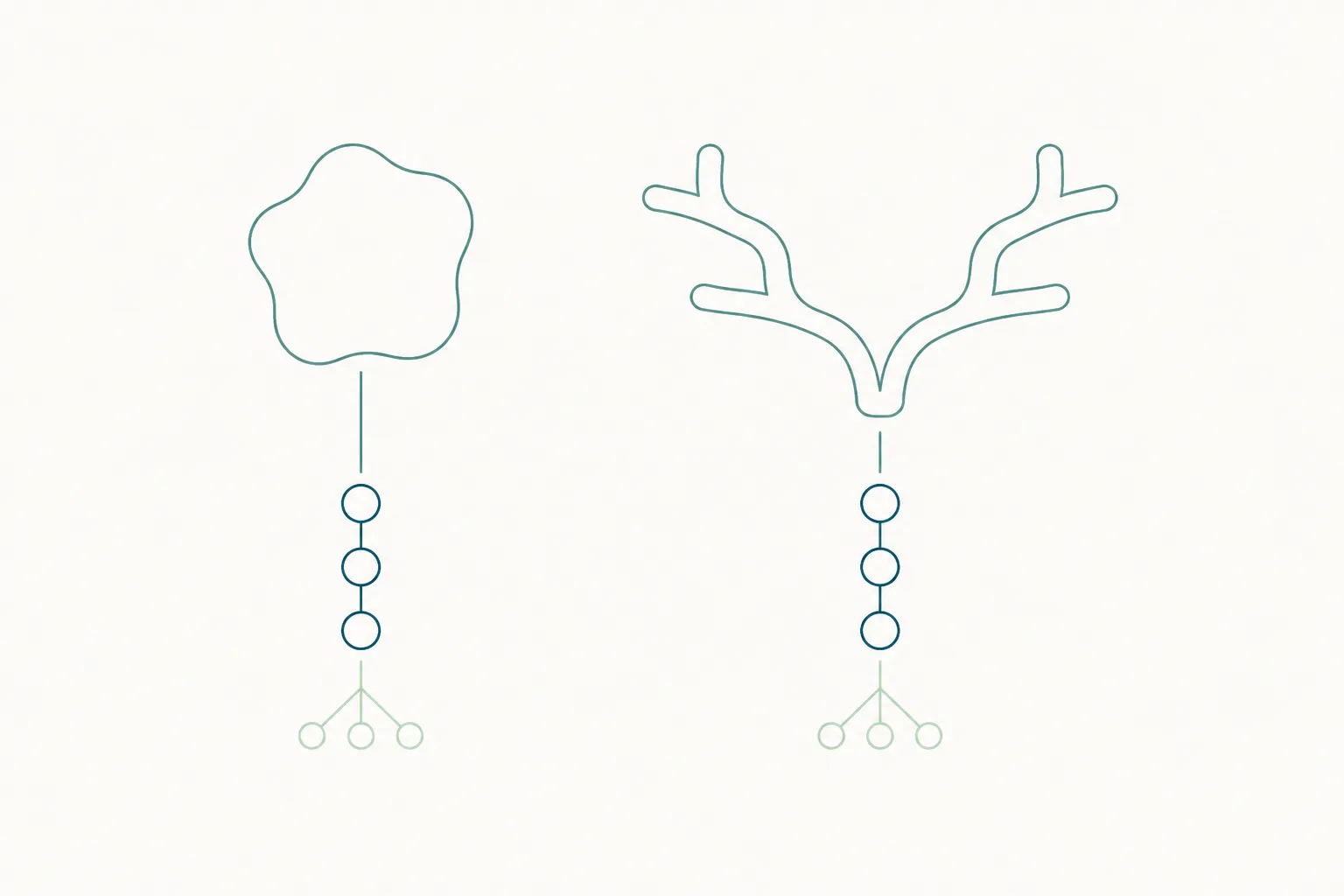
What are Semax and Selank made from?
Two completely unrelated source molecules, joined only by a shared design trick. Semax is based on residues four to ten of adrenocorticotropic hormone — the pituitary hormone that instructs the adrenal glands to produce cortisol. That fragment is the interesting part of the story: it was selected precisely because it does not carry the hormone's steroid-releasing activity, which resides elsewhere in the sequence. Older work had reported behavioural effects of this fragment separate from any effect on the adrenal glands, and Semax is an attempt to keep the first without the second 2.
Selank comes from somewhere else entirely. Its parent is tuftsin, a tetrapeptide sequence found within the heavy chain of an antibody, described in 1970 and named for the university where it was characterised 1. Tuftsin's established identity is immunological: it was noticed for stimulating phagocytosis, the process by which certain white cells engulf material. Nothing about that original description is about the brain, and the route from an immune fragment to a compound studied for anxiety is one of the more surprising turns in the peptide literature.
The shared feature is at the tail end of both molecules. Each has a proline-glycine-proline sequence attached, and it is there for the same reason in both cases: short peptides are dismantled quickly by enzymes in blood and tissue, and this particular addition slows that down considerably. It is a stability modification, not an active component, and it is the fingerprint of the research programme that produced both compounds. When two peptides with nothing else in common carry the same appended tail, they came from the same workshop.
What has each one been studied for?
Semax for brain injury and cognitive effects, Selank for anxiety. The two literatures barely overlap, which is a useful corrective to the habit of treating them as interchangeable members of one category.
Semax's better-documented findings sit in animal neurobiology. One line of work reports that the peptide binds specifically in rat brain tissue and raises levels of brain-derived neurotrophic factor, a protein involved in the survival and growth of neurons 2. Another examined rats after induced focal ischemia and reported broad changes in gene expression, particularly among genes associated with immune and vascular processes 3. Those are substantial pieces of work with modern methods, and they describe a plausible mechanistic direction. They are also rodent studies of induced injury, and the distance between that and a claim about cognition in a healthy person is considerable.
Selank's headline evidence is different in kind. It has been examined in clinical settings for generalised anxiety disorder, including work reporting comparable effect to a benzodiazepine comparator over the study period, together with proposals about how it might act on neurotransmitter systems 4. That is human clinical work rather than animal work, which is more than most compounds discussed on this site can claim. The qualifications matter, though: these are small studies, conducted within one national research tradition, and the primary reports are not readily readable by most people who cite them.
| Semax | Selank | |
|---|---|---|
| Parent molecule | Adrenocorticotropic hormone, residues 4 to 10 | Tuftsin, a fragment of an antibody |
| Original identity of the parent | Hormone signalling to the adrenal glands | Immune signal stimulating phagocytosis |
| Shared modification | Proline-glycine-proline tail | Proline-glycine-proline tail |
| Main research focus | Brain ischemia, neurotrophic factors | Anxiety and related neurotransmission |
| Strongest evidence type | Rodent injury models with modern molecular methods | Small human clinical studies |
| Independent replication outside the originating tradition | Limited | Limited |
| Registered as a medicine | In one country only | In one country only |
| Approved in the United States, United Kingdom or European Union | No | No |
Why is almost all the research in one language?
Because both compounds were developed, tested and registered entirely within one national research system, and that system publishes primarily in its own language and its own journals. Both trace to the same institute within the Russian Academy of Sciences, and both are registered medicines in Russia and nowhere else.
This is a structural fact rather than a suspicious one, and it is worth resisting the reflex to treat it as either disqualifying or irrelevant. Substantial scientific traditions have operated in Russian, in Japanese and in German with limited translation into English, and important work has been done in all of them. A compound developed inside such a tradition acquires a domestic literature, domestic regulatory approval and domestic clinical familiarity, none of which is fake merely because it is inaccessible.
But the consequences for an outside reader are severe and specific. English-language indexes typically carry the title and abstract of these papers and not the full text. An abstract states a conclusion; it does not let you check the method, the sample size, the randomisation, the blinding, the statistical plan or whether the reported outcome was the one specified in advance. Reading only abstracts means reading only what the authors chose to summarise, which is the opposite of scrutiny. Add to that the trial-registration and reporting norms that became standard in international journals over the past two decades and were not uniformly applied earlier or elsewhere, and a great deal of the machinery that ordinarily makes a published claim checkable is simply not available here 4.
How do you weigh a literature you cannot read?
By being explicit about which questions you can still answer and which you cannot, rather than by picking a verdict. This is an unusual position for a reader to be in, and it deserves an honest procedure rather than a shrug.
Some things remain assessable from outside. You can see whether findings have been replicated by groups with no connection to the originators, and for both compounds the answer is that independent replication is thin. You can see whether the modern molecular work that is published in English supports the proposed mechanism, and for Semax it partly does 23. You can see whether a compound has been through the regulatory process of a jurisdiction with published assessment reports, and for both the answer is no outside their country of origin. You can note that registration in one country is a real fact that establishes a domestic regulator was satisfied, while also noting that different regulators apply different standards and that this is precisely why an approval in one place is not automatically recognised in another.
Other things are simply out of reach. You cannot verify a trial's design from an abstract. You cannot assess publication bias in a literature you cannot survey completely. You cannot tell how many studies were run and not published. The correct output of that assessment is not a score but a description of uncertainty, and the description here is that both compounds have more human-facing history than most research peptides and less verifiable evidence than a reader might assume from how confidently they are written about.
- An abstract reports a conclusion; only the full text lets you evaluate how it was reached.
- Independent replication outside the originating group is the strongest available signal when the primary literature is inaccessible.
- Registration as a medicine in one country tells you one regulator was satisfied, on standards that may differ from another regulator's.
- Machine translation of an abstract does not recover the methodological detail that was never in the abstract.
- Neither compound has been assessed by the regulators of the United States, the United Kingdom or the European Union.
What would change the picture?
Independent, registered, English-published trials run by groups with no stake in the originating programme. That is the specific missing ingredient, and it is more achievable here than for most compounds discussed on this site, because unlike a compound with no human history at all, both of these have candidate indications and prior clinical experience to build a protocol from.
For Selank the obvious study is the one its existing literature already gestures at: a randomised, placebo-controlled anxiety trial with a pre-registered primary endpoint, a validated rating scale and a sample large enough to detect the effect its earlier reports imply 4. For Semax the situation is different, because its strongest published work is mechanistic rather than clinical; the useful next step is independent confirmation of the neurotrophic and gene-expression findings in another laboratory, followed by whatever clinical question those findings actually justify 23. In both cases, full-text publication in a journal an outside reader can access is not a bureaucratic detail. It is the entire difference between a claim and a checkable claim.
So the short answer. Semax and Selank are two unrelated molecules from one workshop, wearing the same stabilising tail and filed under the same heading by people who have read neither literature. Their parents are a pituitary hormone and an antibody fragment. Their research directions are brain injury and anxiety. And the most important thing they have in common is the one least often mentioned: the evidence for both sits largely behind a language barrier, which means the confident summaries circulating in English are almost always summaries of summaries.
References
- Tuftsin: a natural phagocytosis stimulating peptide
- Semax, an analog of adrenocorticotropin (4-10), binds specifically and increases levels of brain-derived neurotrophic factor protein in rat basal forebrain
- The peptide semax affects the expression of genes related to the immune and vascular systems in rat brain focal ischemia: genome-wide transcriptional analysis
- Efficacy and possible mechanisms of action of a new peptide anxiolytic medication Selank in the therapy of generalized anxiety disorders and neurasthenia