what went wrong questions
Can a Peptide Degrade Without Looking Different?
Yes, and usually it does. The commonest chemical changes alter a molecule by a single mass unit, by sixteen, or by nothing at all, and none of them touches the appearance of a white solid or a clear solution. Which changes you can see, which you cannot, and the only test that tells them apart.
Yes, and most of the time that is exactly what happens. The chemical changes that account for most peptide degradation alter a molecule of several thousand mass units by sixteen, by roughly one, or by nothing at all, and none of them changes the colour of a white solid, the shape of a freeze-dried cake or the clarity of a solution 123. A peptide can lose a substantial fraction of its intact form and look precisely as it did on the day it arrived.
This is a different question from whether a peptide is genuine. Authenticity asks whether the material was ever what the label claims. This page asks what happens after that: whether material that was once correct has changed since, and whether there is any way to see it. The short answer is that a few kinds of change are visible, most are not, and the only reliable test is analysis of the material as it now exists, compared with the record of what it was.
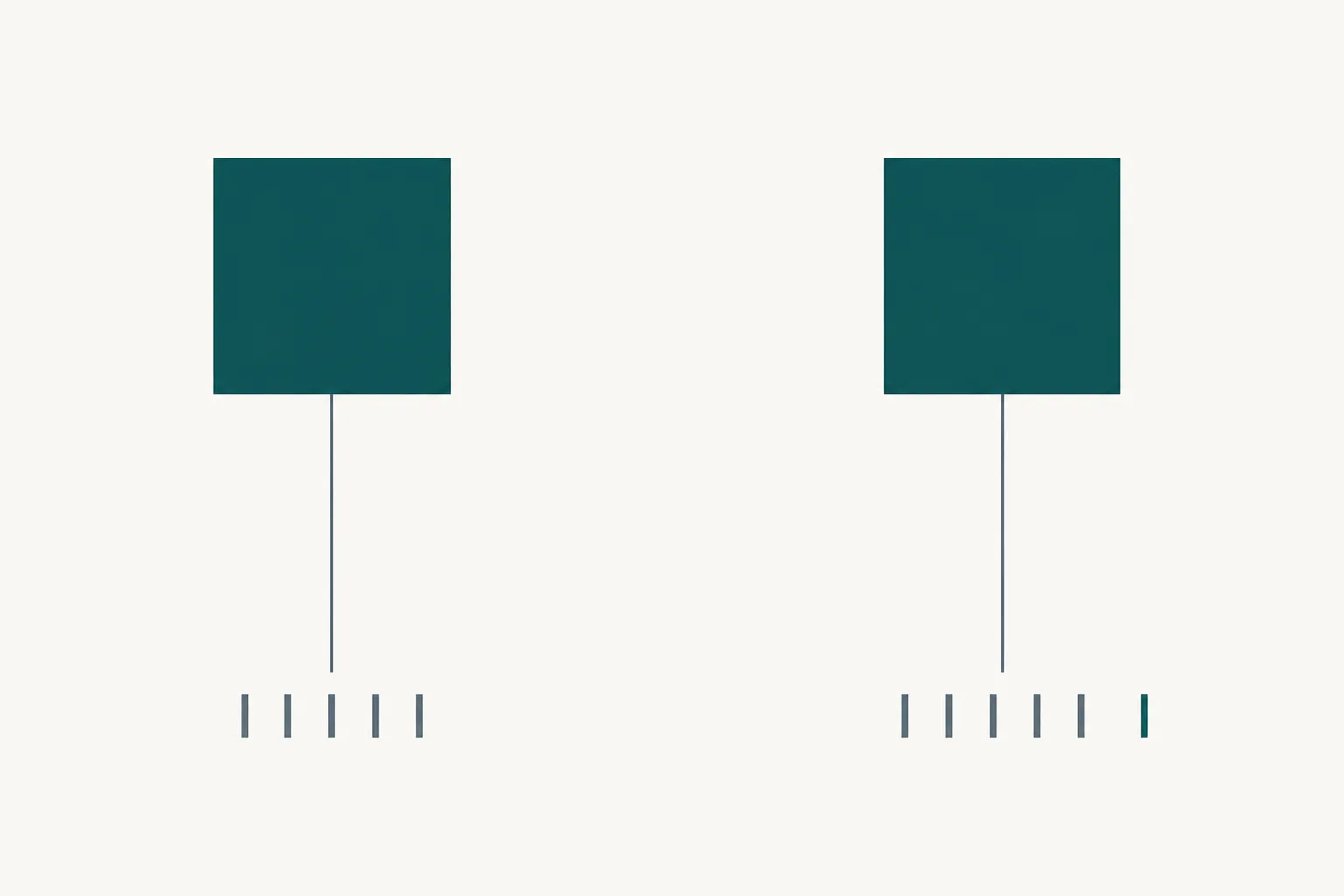
Why does most degradation leave no visible trace?
Because the changes are tiny compared with the molecule, and none of them creates anything that absorbs visible light or scatters it. Seeing something requires either colour, which needs a chromophore absorbing in the visible range, or turbidity, which needs particles large enough to scatter light. The commonest degradation products have neither.
Deamidation is the clearest example. An asparagine or glutamine side chain loses its amide group and becomes an acid, typically by way of a cyclic succinimide intermediate, and the mass of the molecule rises by about one unit 2. The product dissolves the same way, looks the same way and, as a dry solid, is indistinguishable from the original. Yet it carries a different charge, and in some sequences it forms quickly enough to be a major product within days in solution 2.
Oxidation of methionine to its sulfoxide adds a single oxygen atom, sixteen mass units, to a molecule that may weigh several thousand. Methionine sulfoxide is colourless, so the change is chemically real and optically silent 3. The same is true of most backbone hydrolysis: splitting a chain into two fragments produces two colourless molecules that are no more visible than the one they came from 1.
The most elusive change of all is isomerisation. The same succinimide intermediate that drives deamidation can reopen to give isoaspartate, which rearranges the backbone at that point without changing the mass of the molecule at all, and can also scramble the handedness of the residue 2. A mass measurement on its own reports the same number for the altered molecule as for the original. Only a separation technique able to distinguish the two forms will see it.
Which kinds of degradation can you see?
Three kinds: those that make colour, those that make particles, and those that come with a physical change in the solid. They are real signs when they appear, and they cover only a minority of the chemistry that can happen.
- Discolouration. Oxidation of tryptophan and some other aromatic residues produces coloured products, and reactions between amine groups and reducing sugars in some formulations can yellow or brown a solid. Colour means chemistry has happened, though not how much.
- Cloudiness, particles or gel in a solution. These usually reflect aggregation, where peptide molecules associate into assemblies large enough to scatter light. Aggregation is visible only once it is extensive; smaller soluble aggregates can be present in a solution that looks perfectly clear.
- A wet, sticky, shrunken or glassy solid. This shows that the solid has taken up water or been through a thermal event. It is evidence of conditions that speed degradation rather than of the degradation itself.
Of these, aggregation is the one most often mistaken for an early sign, because a hazy solution is so obviously wrong. It is in fact the visible end of a process whose smaller, soluble stages scatter too little light to notice 7. The wet or collapsed solid is similar in kind: it records that moisture reached the material, and moisture is the main accelerant of chemical change in a dry peptide, but the chemistry it enables is itself invisible 4.
Notice what those three have in common. Each one is either the end state of a particular route, such as extensive aggregation, or a sign that the conditions for degradation were present, such as moisture. None of them is an early warning. By the time a peptide solution turns cloudy, the soluble aggregates and the chemical changes that seed aggregation have usually been accumulating unseen for some time 17.
| Route | What changes in the molecule | Visible in a dry solid? | Visible in solution? |
|---|---|---|---|
| Deamidation | Amide side chain becomes an acid; mass rises by about one unit | No | No |
| Isomerisation | Backbone rearranged at an aspartate; mass unchanged | No | No |
| Methionine oxidation | One oxygen atom added; sixteen mass units | No | No |
| Tryptophan oxidation | Ring opened to coloured products | Sometimes, as yellowing | Sometimes, as yellowing |
| Backbone hydrolysis | Chain split into fragments | No | No |
| Aggregation | Molecules associate into larger species | Rarely | Only when extensive |
Does a normal-looking vial mean the peptide is fine?
No. It means none of the visible routes has progressed far enough to show. That is a much weaker statement, and it says nothing about the invisible routes, which are the ones that usually dominate 1.
The asymmetry is worth holding on to. A visible change is informative: colour, turbidity or a wet solid each tell you that something has happened. The absence of a visible change is not informative in the other direction, because the most common forms of degradation would produce no visible change even if they had run to a large extent. Inspection can raise a concern. It cannot clear one.
This is also why the usual lists of signs that a peptide has gone bad mislead. They tend to include things that are not signs of degradation at all, such as a broken or fragmented cake, a film instead of a cake, or powder on the stopper, which are features of the freeze-drying process. And they omit the fact that the most important changes have no signs at all. A checklist that can only ever return a clean result for the commonest problem is not a test.
What makes invisible degradation more likely?
Water, warmth, time, oxygen and the peptide's own sequence, in roughly that order of importance for a dry solid. None of them is visible either, which is why the history of a batch matters as much as its appearance.
Water matters most. Chemical degradation in freeze-dried peptide solids rises steeply with residual moisture, because water supplies both a reactant and the mobility reactions need 4. A solid that has taken up moisture through a failed closure, or by standing open in humid air, can degrade substantially while still looking dry to the eye. In solution the same routes run far faster again, which is why a dissolved peptide is the form most exposed to unseen change 1.
Sequence determines which routes are available. Asparagine followed by glycine is a notoriously fast deamidation site; aspartate followed by glycine is prone to isomerisation; methionine, cysteine and tryptophan are the residues most susceptible to oxidation 23. Two peptides stored side by side under identical conditions can therefore degrade at very different rates, and neither will show it.
What is the only real test?
A stability-indicating analysis of the material as it now exists, compared with the original record for the same batch. Stability-indicating has a specific meaning in formal stability work: the method has been shown to separate and detect the degradation products that matter, rather than simply reporting a single main peak that might hide them 6.
In practice, for peptides, that means chromatography capable of resolving related substances, usually coupled with mass spectrometry. The chromatography separates the intact peptide from deamidated, isomerised, oxidised and truncated forms, which typically run at slightly different positions; the mass spectrometry identifies the oxidised form by its extra sixteen units and the deamidated form by its extra one 5. Isomers that share a mass are told apart by the separation, not the mass. Together they describe what the material has become.
The comparison is what turns a result into an answer. A purity figure measured today means little on its own; set beside the certificate issued for the same batch, using a comparable method, it shows whether new peaks have appeared and whether the main peak has shrunk. That is why a certificate is worth keeping with the batch identifier attached, long after it seems to have served its purpose. It is the baseline against which any later question about change is judged 56.
What should you do if you suspect invisible degradation?
Treat the suspicion as a record-keeping matter first and a chemistry question second. The prompts are usually indirect: results from one batch drifting away from those of the previous one with nothing else changed, material that has been held much longer than usual, a known warm or damp episode in its history, or a solution that has been kept for a while.
Write down the batch, its arrival date, its storage history and anything unusual that happened to it, and treat that batch as a variable rather than a constant in any work that depended on it. If the question matters to the results, the answer is analysis of the current material compared with the batch's certificate, not a closer look at the vial. Nothing in the appearance will settle it, and it is worth resisting the temptation to let a clean-looking solid close the question.
So can a peptide degrade without looking different?
Yes, and for the commonest routes it always does. Deamidation, methionine oxidation, isomerisation and backbone cleavage change a molecule by a mass unit, sixteen units or not at all, and leave both a dry solid and a clear solution looking exactly as they did 123. What can be seen, colour, turbidity and a wet or collapsed solid, reflects a minority of routes and usually a late stage of them.
So looking is worth doing for what it can catch, and never worth relying on for what it cannot. The honest way to know whether a peptide has changed is to measure it with a method able to see the change and to compare the result with what the same batch measured before 56. Everything short of that is an estimate based on history, and the history is only available if someone wrote it down.
References
- Stability of protein pharmaceuticals: an update
- Deamidation, isomerization, and racemization at asparaginyl and aspartyl residues in peptides. Succinimide-linked reactions that contribute to protein degradation
- Chemical instability of protein pharmaceuticals: Mechanisms of oxidation and strategies for stabilization
- Solid-state chemical stability of proteins and peptides
- Related impurities in peptide medicines
- Stability Testing of New Drug Substances and Products Q1A(R2)
- Protein aggregation and its inhibition in biopharmaceutics