quality questions
Why Do Peptides Come as a Powder?
Because peptides fall apart far faster in water than out of it. The three main degradation routes all run better in solution, and removing the water buys shelf life measured in a different order of magnitude entirely.
Because peptides degrade far faster in solution than out of it. Water is not a neutral medium for these molecules — it is a participant in the main reaction that takes them apart, and it supplies the mobility that every other degradation route needs. Take the water away and the chemistry very largely stops.
The size of the effect is what makes this decisive rather than merely preferable. A dry, sealed, cold peptide is typically stable for years. The same peptide dissolved and left at room temperature is often measured in days. That is not a modest improvement bought at the cost of an inconvenient extra step; it is the difference between a product that can be shipped across the world and one that cannot.
Why does being dry matter so much?
Because the main routes by which a peptide falls apart either consume water directly or depend on the freedom of movement that only a liquid provides. Three mechanisms account for most of what happens, and all three are slowed enormously in a solid.
Hydrolysis is the first and the most fundamental. The bond joining one amino acid to the next is an amide bond, and amide bonds react with water to split into their two halves. In solution the peptide is surrounded by the very reagent that cleaves it, and the rate depends on temperature, on pH, and on the sequence — some junctions are notoriously more labile than others, with aspartic acid residues followed by proline or glycine being the classic weak points. In a properly dried solid there is very little water available and very little molecular mobility to bring reacting groups together, so the reaction that dominates in solution barely proceeds at all 1 2.
Deamidation is the second, and it is quieter because it does not break the chain. Asparagine and glutamine side chains carry an amide group that can be lost, converting the residue into an acid and changing the molecule's charge. In peptides the reaction usually runs through a cyclic succinimide intermediate, and it is startlingly fast in some sequence contexts: a model peptide with asparagine followed by glycine was measured with a half-life of around 1.4 days at body temperature and neutral pH 3. The product differs from the original by about one mass unit, which makes it subtle to detect and no less consequential for the molecule's behaviour.
Oxidation is the third, and it is the one that does not strictly require water. Methionine, cysteine, tryptophan, tyrosine and histidine side chains are all susceptible, and the reaction is driven by dissolved oxygen, trace metal ions, light and peroxide impurities in solvents and excipients 4. Solution helps it along by supplying all of those at once: an aqueous vial holds dissolved oxygen and whatever metal traces the water and glassware contribute. A sealed dry vial, typically stoppered under vacuum or an inert gas, provides far less of each.
There is a fourth route worth naming even though it is mostly a solution phenomenon. Peptides in water can associate with one another and with surfaces, forming aggregates that may not redissolve, and agitation, concentration changes and repeated freezing and thawing all encourage it 1. In the dry state the molecules are already immobilised and the question largely does not arise.
| Route | What changes | Needs water? | Accelerated by |
|---|---|---|---|
| Hydrolysis | Backbone amide bond cleaved, chain split | Yes — water is the reagent | Low or high pH, heat, labile sequence motifs |
| Deamidation | Asparagine or glutamine side chain becomes an acid | Proceeds readily in solution | Neutral to alkaline pH, heat, asparagine-glycine motifs |
| Oxidation | Sulfur- and ring-containing side chains oxidised | No, but solution supplies the drivers | Dissolved oxygen, trace metals, light, peroxides |
| Aggregation | Molecules associate, sometimes irreversibly | Largely a solution phenomenon | Concentration, agitation, surfaces, freeze-thaw |
How much longer does a dry peptide actually last?
Roughly two to three orders of magnitude longer — a factor of hundreds to thousands, not a factor of two. The exact numbers are sequence-dependent and no single figure covers every compound, but the shape of the comparison is consistent enough to be useful.
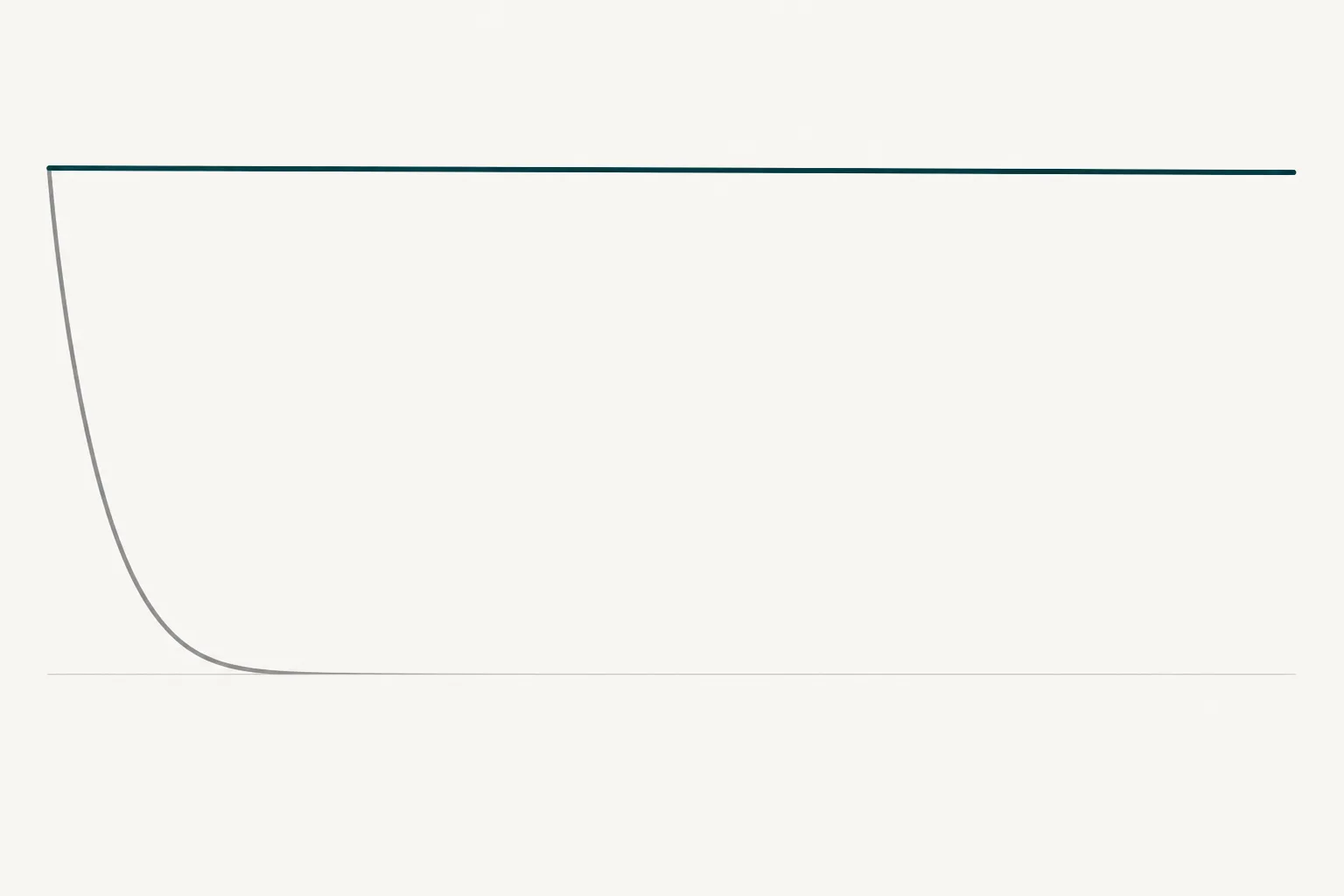
Freeze-dried and stored cold in a sealed container, peptides are commonly assigned shelf lives measured in years, and the storage conditions specified for solid protein and peptide products reflect the expectation of long-term stability in that state 5. The same material in aqueous solution at ambient temperature is typically a matter of days to a few weeks before measurable change appears; refrigerated, weeks to months. Multiply through and the gap is what it looks like on any stability plot: one line that stays flat for a very long time and one that visibly falls away.
Being dry is not a binary state, though, and this is where the detail matters. Freeze-drying never removes all the water, and the small amount that remains largely determines how stable the resulting solid is. Degradation rates in freeze-dried peptide and protein solids rise steeply with residual moisture content, because water restores both a reagent and the local mobility that reactions need 2. This is why residual moisture is a controlled specification for lyophilised products, and why a vial that has taken up water — through a failed seal, or by standing open in humid air — has lost part of the protection the dry form was providing 5.
Temperature multiplies whatever the moisture situation is. As a broad rule of thumb for chemical reactions, rates roughly double for every ten degrees Celsius of warming, which is why the same product carries very different expected lifetimes at freezer, refrigerator and room temperature. The dry state does not exempt a peptide from that relationship. It simply starts the clock so much slower that ordinary temperature variation stops being an emergency.
What does the dry form have to do with shipping?
It is what makes shipping possible at ambient temperature at all. A parcel crossing a continent spends days in vehicles, warehouses and sorting facilities where the temperature is not controlled and can be well above room temperature in summer. A solution exposed to that has been running its degradation reactions the entire time, at an elevated rate, with no record of how hot it got.
A dry solid absorbs the same journey with far less consequence, because its reactions were barely proceeding to begin with. This is the practical reason the dry form is the near-universal shipping format for peptides worldwide: it converts a cold-chain problem into an ordinary logistics problem, and cold chain across borders is expensive, fragile and difficult to verify after the fact.
Freezing behaves differently in the two forms too, which is less obvious and worth spelling out. Freezing a solution is not simply making it colder. As ice forms, everything dissolved in the remaining liquid becomes concentrated into a shrinking volume, buffer components can crystallise out and shift the pH sharply, and a large new ice-water interface appears for molecules to unfold against. Repeated freeze-thaw cycles are consequently a recognised stress on peptides and proteins in solution 1. A dry solid has no such phase to concentrate, so a cold shipment or a temperature excursion in the freezer is uneventful for it.
Why would a pre-mixed solution be a warning sign rather than a convenience?
Because it removes the one thing keeping the material stable in exchange for a convenience that does not come close to compensating. A ready-mixed vial has been in contact with water since it was filled, and everything described above has been running for the whole of that period.
The concrete difficulty is that the buyer inherits an unknown history. With a dry vial, the clock effectively starts when the material meets water, and the recipient controls that moment. With a pre-mixed one, the clock started at an unknown date and has been running at unknown temperatures through manufacture, storage and transit. Nothing about the appearance of a clear liquid reports on any of that, so the visual check that at least catches gross problems in a dry vial is unavailable.
A stable aqueous formulation is not impossible — plenty of peptide medicines exist as licensed solutions — but it is an achievement rather than a default, and it requires things a research reagent generally does not carry: a buffer chosen for that specific sequence, an antimicrobial preservative, control of dissolved oxygen and trace metals, protection from light, and stability data establishing how long the formulation actually holds and under what conditions 1 4. Those are the questions a pre-mixed presentation raises, and they are answerable in principle.
So the reasonable position is not suspicion of a form, but attention to what has been demonstrated. A solution offered without a stated buffer, a stated storage condition and stability data supporting the claimed shelf life is being described by its packaging rather than by its contents, and the word convenient is doing work that the evidence has not done.
Is the powder form ever a disadvantage?
Yes, in three specific and fairly minor ways, and it is worth being straightforward about them rather than presenting the dry form as costless. None of them outweighs a hundredfold difference in stability, but they are real.
- It adds a step before the material can be used, and any additional step is an additional opportunity for something to go wrong.
- Freeze-dried solids are porous and hygroscopic. Once a container is opened, material can take up moisture from the air relatively quickly, and moisture is the main thing the dry form exists to exclude.
- Very low masses of light, static-prone powder are difficult to see and to handle, which is why vials are filled to a nominal quantity by the manufacturer rather than left to be weighed out later.
Set against a shelf life measured in years instead of days, these are the cost of doing business, and the trade has been settled the same way across the whole field for decades. That consistency is itself informative: the dry vial is not a convention anyone chose for appearance or economy. It is what the chemistry of amide bonds in water leaves as the only workable option.
References
- Stability of protein pharmaceuticals: an update
- Solid-state chemical stability of proteins and peptides
- Deamidation, isomerization, and racemization at asparaginyl and aspartyl residues in peptides. Succinimide-linked reactions that contribute to protein degradation
- Chemical instability of protein pharmaceuticals: Mechanisms of oxidation and strategies for stabilization
- Lyophilization and development of solid protein pharmaceuticals