quality questions
Why Do Two Vials of the Same Peptide Look Different?
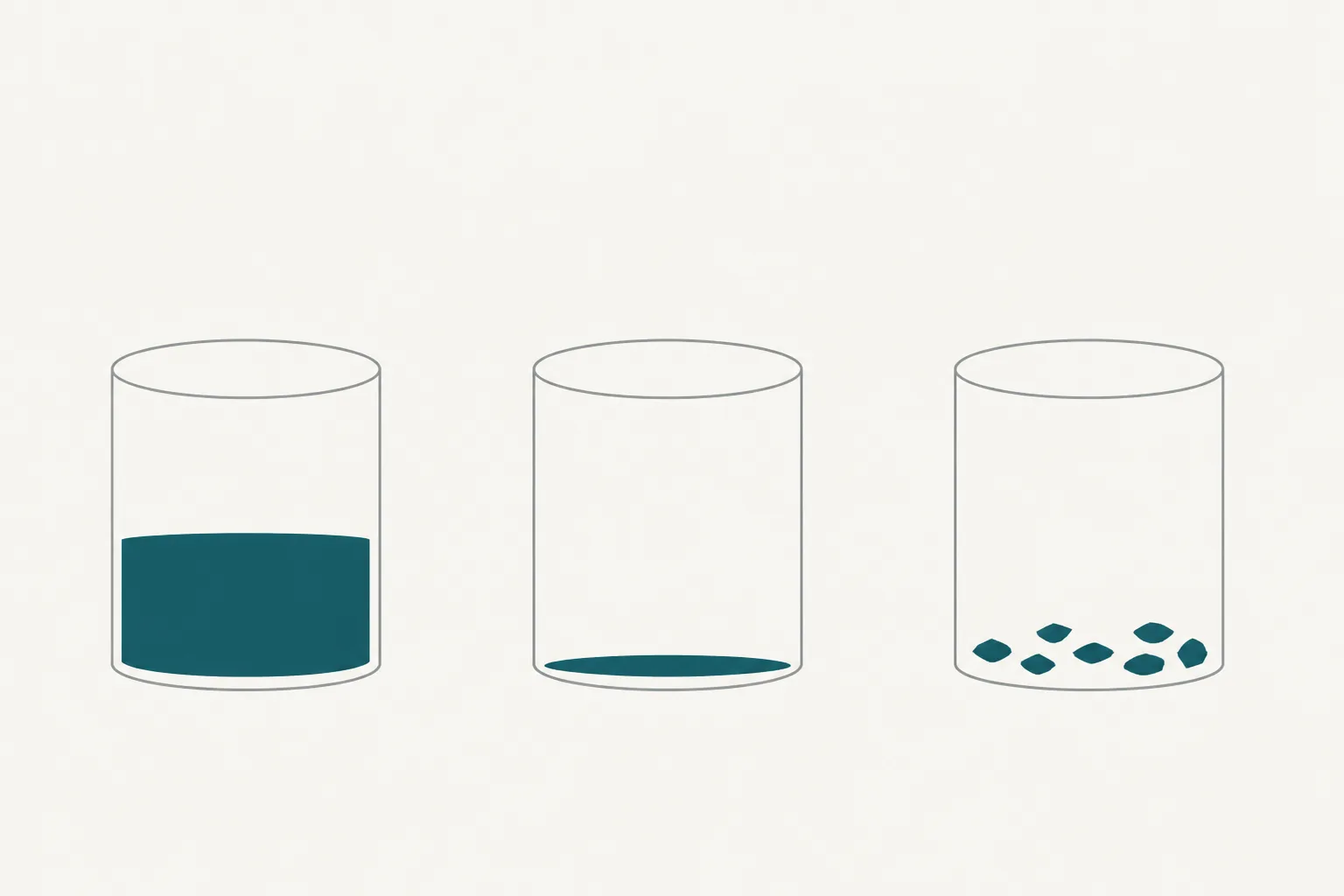
One is a firm cake, one is a thin film, one is loose powder scattered round the base. Almost always this is the freeze-drying cycle showing through, not a difference in what is inside — and vials from a single run routinely differ.
Because they were dried slightly differently, not because one is better than the other. What you see in the bottom of a vial is set almost entirely by the freeze-drying cycle — how fast the solution froze, how much solid was dissolved in it, and how the water was removed — and none of those variables track whether the molecule inside is correct.
This causes more unnecessary worry than any other feature of buying research peptides, and it is worth defusing early. A firm white cake, a thin glassy film, a loose fluffy powder and a scatter of fragments around the base are all normal outcomes for the same compound. Vials filled in a single production run, from a single solution, in a single freeze-dryer, routinely come out looking different from one another.
What actually causes the difference in appearance?
The freeze-drying cycle, and specifically what the ice did on its way out. Lyophilisation runs in three stages: the solution is frozen, then most of the water is removed by sublimation under vacuum, then the small amount of water still bound to the solid is driven off by gentle warming 2. Each stage leaves its fingerprint on what remains.
Freezing is where the structure is decided. As the solution freezes, ice crystals grow and push the dissolved material into the spaces between them. When those crystals later sublime, they leave voids exactly where they were, and what is left behind is the solid skeleton that occupied the gaps 4. Fast freezing makes many small crystals and therefore a fine-pored, more delicate structure; slow freezing makes fewer, larger crystals and a coarser, more open one.
That is why one load can produce a range. Vials at the edge of a shelf cool differently from vials in the middle, nucleation is a somewhat random event that does not happen at the same instant in every container, and heat transfer varies with how well each vial sits against the shelf 2. These are ordinary process realities rather than defects, and they mean appearance varies within a batch before it varies between batches.
The second big factor is simply how much solid there was to begin with. Dry a few milligrams of peptide from a millilitre of water and the total solid content is a fraction of a per cent, which is nowhere near enough to build a self-supporting cake. Formulations designed to produce a handsome cake include a bulking agent such as mannitol or trehalose for precisely this reason, and those additives also serve to protect the molecule during drying 3. A vial with no bulking agent has almost nothing to hold a shape with, and it looks like it.
What do a cake, a film and a loose powder each mean?
They mean different amounts of solid dried under different conditions, and in the ordinary case nothing beyond that. Taking them one at a time makes the pattern obvious.
- A firm, uniform cake sitting in the base. Enough dissolved solid, and a cycle run comfortably below the temperature at which the frozen matrix would soften. This is what a formulation containing a bulking agent is designed to produce.
- A thin translucent film or glaze coating the bottom or creeping up the wall. Very little solid dried from a small fill volume. Common where a few milligrams were dried with no bulking agent, and entirely expected.
- A loose fluffy powder, or a cake that has become fragments. Usually a cake that fractured. Freeze-dried solids are extremely porous and mechanically weak, and ordinary vibration in transit or a knock during handling is enough to break one apart.
- A cake that has shrunk away from the glass wall, leaving a visible gap. Shrinkage during drying is normal and is one of the standard cosmetic outcomes of the process.
- A cake with a denser, glassier base or a partly slumped upper surface. The cycle ran close to the point where the frozen matrix loses rigidity. This has real process significance but is frequently cosmetic in effect.
- Material clinging to the stopper or upper wall. Fine, low-density powder is easily displaced by static or by the vacuum breaking at the end of the cycle.
The scale of the variation surprises people because they have no reference point. Work on what constitutes acceptable appearance in freeze-dried products sets out how wide the normal range is, and how many of the features that look alarming — shrinkage, cracking, fragmentation, uneven surfaces — are cosmetic attributes rather than indicators that the active molecule has been damaged 1.
Does a broken or collapsed cake mean the peptide has degraded?
No, and this is the single most useful thing to know here. A broken cake is a mechanical event. Nothing about a porous solid fracturing under vibration changes the chemistry of the molecules making up that solid, and a fragmented cake is not evidence that anything has gone wrong with the contents.
Collapse is a slightly different phenomenon and deserves its own treatment, because it is often used as a synonym for ruin when it is not one. Every frozen formulation has a temperature above which the concentrated, unfrozen phase loses enough rigidity that the structure slumps rather than holding its shape as ice leaves. Running primary drying too warm crosses that threshold, and the result is a dense, shrunken, sometimes glassy solid instead of an open cake 2.
Collapse does have consequences worth naming honestly. A collapsed solid has far less surface area, which makes the final drying step less effective and can leave more water behind, and it may take longer to dissolve. Higher residual moisture matters because water is the main driver of chemical change in a dry solid 5. But this is a chain of possibility, not an automatic outcome — a collapsed cake and a degraded molecule are two separate findings, and the assessment in the field is that visual cake defects are largely cosmetic unless they are accompanied by evidence of a real change 1.
The practical position, then, is proportionate: a fragmented or shrunken cake is not a reason for alarm, a visibly collapsed and glassy one is a reason to pay closer attention to storage and to how the material behaves, and neither is by itself proof of anything about the peptide.
When does appearance genuinely indicate a problem?
When it shows water, colour, or a broken container. Those three categories cover essentially every appearance-based signal that carries real weight, and all three are about handling and integrity rather than about the identity of the compound.
Moisture is the important one. Anything wet, sticky, syrupy or slumped into a liquid where a dry solid should be indicates that water is present, either because the drying cycle did not finish its work or because the container closure has let water vapour in. Residual water is the principal accelerant of solid-state degradation: reaction rates in freeze-dried solids rise sharply with moisture content, because water supplies both a reagent and the molecular mobility that reactions need 5. A visibly damp vial is therefore a genuine finding.
Colour is the second. Peptide solids are white to off-white. Distinct yellowing, browning or pinkness indicates chemical change of some kind, and while it does not identify what has happened, it is a real departure from the expected state. Related to this is a vial that appears to have melted and re-solidified into a glassy puddle, typically after a spell at high temperature in transit.
Container integrity is the third: a lifted or misseated stopper, a damaged crimp, a cracked vial. Freeze-dried vials are usually stoppered under vacuum or an inert gas, so a closure that has failed has also exposed the contents to air and moisture for an unknown period 4. That is worth noticing regardless of how the solid inside looks.
| What you see | Usual cause | Cause for concern? |
|---|---|---|
| Firm uniform cake in the base | Adequate solids, well-controlled cycle | No |
| Thin film or glaze on the glass | Very low solids, no bulking agent | No |
| Loose powder or broken fragments | Cake fractured in handling or transit | No |
| Cake shrunken away from the wall | Normal shrinkage during drying | No |
| Material on the stopper or upper wall | Static or vacuum release at cycle end | No |
| Dense, glassy, partly slumped solid | Cycle ran near the collapse temperature | Usually cosmetic; may mean higher residual moisture |
| Any visible liquid, stickiness or syrup | Moisture ingress or an incomplete cycle | Yes |
| Yellow, brown or pink discolouration | Chemical change of some kind | Yes |
| Lifted stopper, damaged seal, cracked glass | Container closure failure | Yes |
Why is appearance such a poor test of authenticity?
Because the appearance is made by water leaving a solution, and water leaves every solution in much the same way regardless of what was dissolved in it. The visible result is produced by the process, not by the identity of the solute, so it has essentially no power to discriminate between one dissolved substance and another.
Follow that through and the conclusion is stark. A vial of the correct peptide, a vial of an entirely different peptide, and a vial containing only bulking agent, all dried under the same cycle at the same solids concentration, would be visually indistinguishable. Nothing about the cake reports on sequence, purity or quantity, because none of those properties has any influence on how ice sublimes.
That does not make looking pointless. Inspection is a fast and free check on the things it can actually see: whether the container survived, whether the contents are dry, whether the material has changed colour. Those are worth confirming on arrival, and they are the questions inspection is built to answer.
The summary is short and reassuring. If two vials look different, the overwhelmingly likely explanation is that ice behaved slightly differently in each of them. If a vial is wet, discoloured, or no longer sealed, that is a different observation and worth acting on. And if the question is whether the contents are what the label claims, the vial will not answer it — no dry solid ever has.
References
- Lyophilized Drug Product Cake Appearance: What Is Acceptable?
- Design of freeze-drying processes for pharmaceuticals: practical advice
- Rational design of stable lyophilized protein formulations: some practical advice
- Lyophilization and development of solid protein pharmaceuticals
- Solid-state chemical stability of proteins and peptides